
What a Yoga Class About Eckhart Tolle's The Power of Now Taught Me About Presence
Jun 26, 2026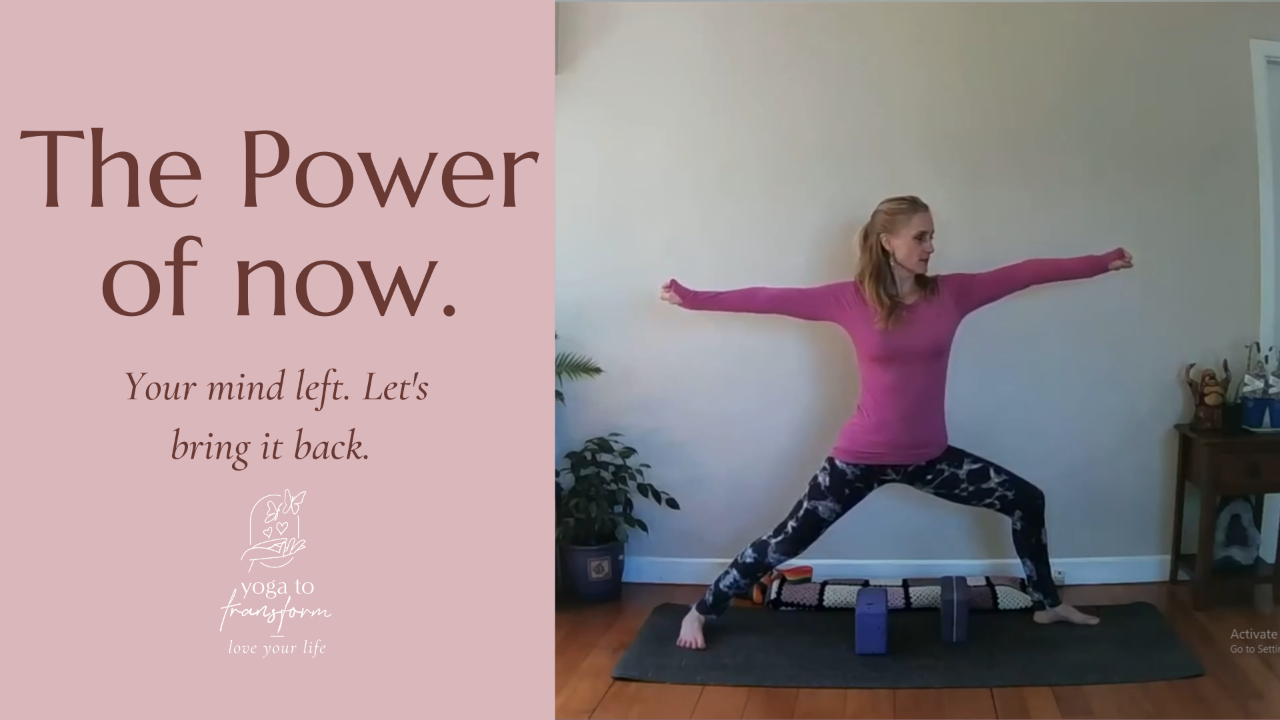
There's a moment in every yoga class where someone's mind leaves the room.
You can feel it — that slight softening of attention, the eyes that go distant, the breath that shortens. The body is still on the mat. But the person is somewhere else entirely. Thinking about what they need from the supermarket. Replaying something someone said. Planning the email they'll write as soon as they get home.
It happens to all of us. It happened to me on my bike.
The other week I was riding through the city centre in Christchurch and I watched a man step out onto the road directly in front of me. No earbuds. No phone. Just not there. I called out, he didn't respond. He kept moving. It was only when I nearly reached him that he looked up, startled, genuinely surprised and said: "I didn't see you there."
I know. I could see that.
That moment stayed with me. Because I'd been reading Eckhart Tolle's The Power of Now all month, and what I'd been sitting with is exactly what I watched happen on that street. He wasn't in the past or the future because of something dramatic. He was just drifting, the way we all drift, dozens of times a day. And the consequence in that moment was serious.
Most of the time it isn't serious. Most of the time we just miss things. The conversation with our child. The colour of the sky. The feeling in our body. The full experience of being alive right now.
Tolle's central argument is that the present moment is where your life actually is. Not in your memories. Not in your plans. Here. And the degree to which we're pulled away from here, by habit, by worry, by the mind's endless loop of past and future, is the degree to which we're missing our own lives as they happen.
Why yoga is one of the most direct practices for presence
We built this week's class around that teaching, and what struck me again in the delivery of it is that yoga isn't just useful for presence because it's calming or mindful or good for stress. It's useful because the body is always in the present moment.
Your body cannot be in yesterday. It cannot be in next Tuesday. It's here, on the mat, feeling the four corners of your feet pressed into the ground, feeling the muscles hug the bones, feeling the breath move in and out. When you come into your body, you come into now.
That's why physical anchoring works as a mindfulness practice. Not as a metaphor. As a mechanism.
In the class, we used grounding cues throughout, gripping the mat with the fingers in downward dog, pressing the big toe mound into the floor in standing poses, feeling the clothing against the skin in the opening seated breathing. These aren't decorative instructions. They're invitations to be here. To use sensation as the anchor that pulls attention back from wherever it drifted.
Tolle describes this beautifully: witnessing what's happening without the stories we add to it. Our brains want to narrate every sensation. That tightness in the hip becomes evidence of something wrong. That shortness of breath becomes a story about our fitness or our age or the week we've had. The practice is to feel the sensation and release the story. Just notice what's there.
This is exactly what we were working on in Warrior Two, in Triangle, in the deep forward folds and the twists. Not just shapes. A practice of returning. Over and over, returning.
The 70,000 thoughts
Kristina mentioned in the class that we have roughly 70,000 thoughts a day. Most of them on repeat. Most of them not life-affirming.
What the yoga practice does, what this class was asking you to do, is reduce that number. Not to silence the mind, which is not the goal and not possible, but to notice the thoughts passing through without following each one down the alley. To watch them and return to the breath. To watch them and return to the foot on the mat. To watch them and return to now.
Every thought you don't follow is a thread of attention returned to yourself. And when you gather enough of those threads back, you begin to notice something: a kind of aliveness. A sense of being present in your own experience. Tolle calls it bliss. We'd call it just being here, fully, without fighting it.
What you can take into the rest of your week
You don't need a yoga mat to practise this.
The next time you notice your mind has left the room, mid-conversation, mid-meal, mid-anything, try the same technique we used in class. Come to your breath. Feel your feet on the floor. Notice three things you can actually sense right now. The temperature of the air. The weight of your body in the chair. The sounds in the room. Use those sensations as the anchor.
It's not complicated. But it is a practice. It works exactly the way the yoga works — through repetition, through returning, through not making yourself wrong when you drift and just beginning again.
That's the whole practice.
If you'd like to do the full mindful yoga flow we built around these teachings, it's on our YouTube channel now. Have your mat, blocks, and a strap handy. All levels welcome.
And if you haven't read The Power of Now, there's a good reason it's been on bestseller lists for 25 years. We'd love you to read it alongside practising with us.
See you on the mat.
From my heart to yours,
Kristina, Yoga to Transform
If you would like to know more about our services including our courses, workshops, coaching or retreats then click here
Stay connected with news and updates!
Join our mailing list to receive the latest news and updates from us as we release new blogs and services.
